Goal
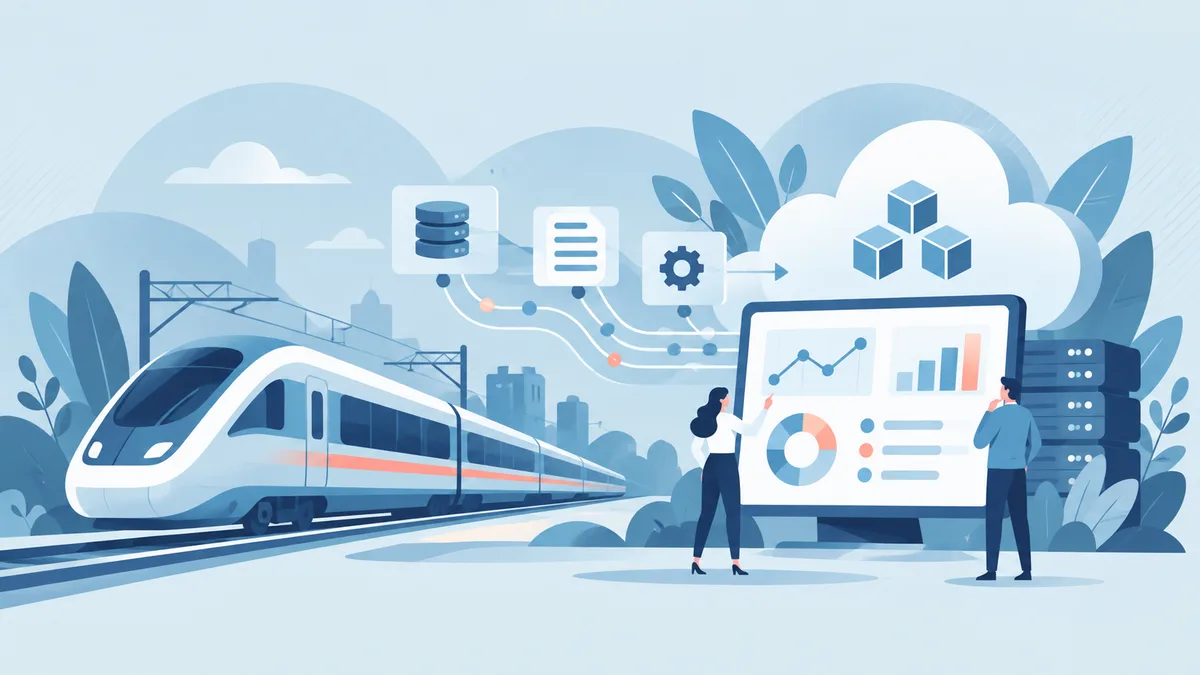
Modernise business-critical rail data processing by replacing legacy desktop and manual workflows with reliable, scalable and governed AWS data pipelines.
The programme needed to move important operational datasets — including ticket sales, ticket scans, reservation availability, customer-experience feeds and delay-repay data — onto a centrally managed cloud platform without disrupting existing reporting or downstream consumers.
The objective was not simply to “move data to AWS”. It was to create production-ready data services that could be trusted, monitored, maintained and extended by the wider engineering team.
Role
As a Contract AWS Data Engineer, I designed, built, tested and operationalised production data pipelines across LNER’s AWS data platform.
My work covered the full delivery lifecycle: understanding existing business processes, analysing legacy outputs, designing cloud-native replacements, building ingestion and transformation logic, implementing data-quality controls, supporting user acceptance testing, deploying infrastructure and resolving production issues.
- Legacy-to-cloud modernisation. Replaced Alteryx and manually operated data processes with automated AWS pipelines designed for central ownership, scalability and long-term maintainability.
- Production data engineering. Built ingestion and transformation workflows across APIs, files and databases using Python, SQL, PySpark, AWS Glue, Lambda, Step Functions, S3, Athena and related AWS services.
- Incremental and historical processing. Designed pipelines capable of processing new data incrementally while also handling large historical backfills and safely bringing legacy history into the same curated datasets.
- Data quality and reconciliation. Implemented completeness, uniqueness, schema and business-rule validation so data problems were detected before reaching downstream users. Outputs were reconciled against existing processes during UAT to prove that the new platform could safely replace them.
- Production reliability. Designed restartable processing, pagination and continuation behaviour, deterministic record keys, retries and operational controls so pipelines could recover safely from failures rather than requiring manual rebuilding.
- Secure external data delivery. Built controlled outbound feeds to external partners using encryption, managed credentials and restricted cloud access rather than exposing internal data stores directly.
- Infrastructure and deployment. Delivered cloud configuration and environments using Terraform/Terragrunt and CI/CD, supporting repeatable deployment across development, staging and production.
- Stakeholder collaboration. Worked directly with engineers, analysts, data providers and business users to understand requirements, resolve discrepancies and turn existing operational processes into maintainable technical solutions.
- Technical ownership and documentation. Produced detailed pipeline and operational documentation so systems could be understood, supported and extended after delivery.
The work ranged from straightforward scheduled extracts to complex multi-stage pipelines combining incremental APIs, historical data, transformation, quality controls and curated AWS data stores.
Capability
The resulting capability moved business-critical processing away from individually operated desktop workflows and into centrally managed cloud services.
Business Impact
- Ticket scan data. Replaced a legacy Alteryx process with a governed AWS pipeline, giving teams a more reliable source for ticket-scan analysis and reporting. Historical migration covered 100+ million scan records.
- Ticket sales data. Brought historical and ongoing ticket-sales data into one automated cloud pipeline, improving consistency for reporting and reconciliation while reducing reliance on manual processing.
- Reservation and ticket availability. Replaced legacy reservation workflows with a cloud-based data service, giving the business more reliable visibility of seat and ticket availability across services, journeys and booking horizons.
- Customer-experience punctuality feed. Automated the daily delivery of disrupted-train data into the customer-experience platform, supporting timely analysis of how disruption affects passenger experience and removing dependence on the legacy feed.
- Delay Repay data delivery. Automated the daily flow of rail transaction data into Delay Repay processing, replacing repeated manual extraction with a faster, more reliable and controlled data feed.
- Safer migration. Reconciled new cloud outputs against existing processes before cutover, reducing the risk of disrupting reporting or downstream users.
- Better resilience. Built pipelines to recover safely from failures, rerun where needed and reduce manual intervention.
- Stronger data quality. Embedded validation so incomplete, duplicate or invalid data could be caught before reaching analysts, reports or external consumers.
- Easier future change. Replaced individually operated desktop workflows with centrally managed, documented cloud services that were easier to support and extend.
How
- Scalable cloud processing. AWS-native services supported growing data volumes, historical backfills and recurring production workloads.
- Built-in data quality. Completeness, uniqueness, schema and business-rule checks were embedded into processing.
- Recoverable processing. Incremental state, deterministic keys and restartable workflows supported safe continuation after interrupted runs.
- Secure data delivery. Encryption, AWS IAM, Secrets Manager and governed external delivery patterns protected business data.
- Operational transparency. Logging, orchestration and documented run behaviour made failures easier to diagnose and recover.
- Maintainable engineering. Infrastructure as Code, CI/CD and reusable platform patterns supported repeatable deployment across environments.
- Controlled migration. Legacy outputs were reconciled against new AWS pipelines before production adoption.
Tech Stack
- Programming & Data Engineering: Python, SQL, PySpark
- AWS Data Processing: AWS Glue, Lambda, Step Functions
- AWS Storage & Analytics: S3, Athena, Redshift
- Data Lake Technologies: Apache Hudi, Parquet
- Orchestration & Scheduling: AWS Step Functions, EventBridge
- Security & Access: AWS IAM, Secrets Manager, Lake Formation
- Infrastructure as Code: Terraform, Terragrunt
- DevOps: Git, CI/CD, GitHub Actions
- Data Integration: REST APIs, JDBC, CSV, JSON, Parquet, SFTP
- Data Quality: Schema validation, completeness checks, uniqueness controls, reconciliation, deterministic record keys
- Secure Delivery: PGP encryption, SSH/SFTP, cross-account AWS delivery
- Collaboration & Delivery: Jira, Confluence, technical documentation, UAT and stakeholder reconciliation
Year
2026